
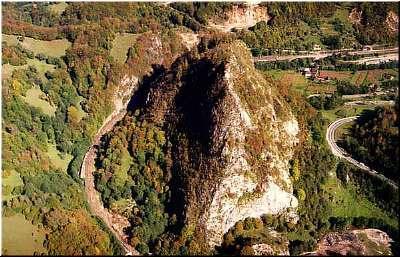
 The Dacian fortress of Bănița is one of the six Dacian Fortresses of the Orăștie Mountains, in Romania. Together with the other Dacian fortresses in the area, it was designated as an UNESCO World Heritage Site in 1999. The fortress dates from Burebista’s time, and was later restored under King Decebal. The purpose of the fortress was to block access to Sarmizegetusa Regia from the south. The site’s fortifications includes enclosure walls, towers, platforms for battle, wave of defense. The fortress functioned until the conquest of Dacia by the Roman Empire.
According to the UNESCO site:
“The Băniţa fortress was constructed on a steep conical hill in the Jiu valley. The only side on which the summit was accessible was on the north, and this was defended by a strong stone wall in murus dacicus style. The fortress itself was entered through a gate leading to a monumental limestone stairway with andesite balustrades. The plateau above has three terraces at different levels.”
Province or Region: Banita village, Banita commune, Petrosani city, Hunedoara County.
Geographical coordinates:
– Latitude 47°27’ – 45°497’ North,
– Longitude 23°09’ – 29°31’ East.
| Dacian fortress of Bănița | |
|---|---|
  Location within Romania | |
| 45°27′06″N 23°18′49″E / 45.4517°N 23.3135°E | |
| Location | Piatra Cetăţii, Cetatea de pe Dealul Bolii, Bănița, Hunedoara, Romania |
| History | |
| Event | Trajan's Dacian Wars |
| Site notes | |
| Elevation | 902 m (2,959 ft)[1] |
| Condition | Ruined |
| Reference no. | HD-I-s-A-03156 [2] |
| Part of | Dacian Fortresses of the Orăștie Mountains |
| Criteria | Cultural: (ii), (iii), (iv) |
| Reference | 906 |
| Inscription | 1999 (23rd Session) |
Dacian fortress of Bănița is one of the six Dacian Fortresses of the Orăștie Mountains, in Romania. Together with the other Dacian fortresses in the area, it was designated as a UNESCO World Heritage Site in 1999.
Gallery
[edit] Axes and hatchet from the Dacian fortress of Bănița at Orăștie Ethnography Museum
- Hinges, cramp Iron and chain link
- Hinges, cramp Iron and chain link - close up


See also
[edit]References
[edit]- ↑ "IMPLANTUL DE PĂR Arad". Implant de Par Arad - Patrimoniul Romanesc.
- ↑ "National Register of Historic Monuments in Romania, Hunedoara County" (PDF). www.inmi.ro. Archived from the original (PDF) on 27 February 2012. Retrieved 15 October 2012.
External links
[edit]
| Tribes (List) | |||||||||||||||||
|---|---|---|---|---|---|---|---|---|---|---|---|---|---|---|---|---|---|
| Kings |
| ||||||||||||||||
| |||||||||||||||||
Wars with the Roman Empire |
| ||||||||||||||||
| Roman Dacia / Free Dacians |
| ||||||||||||||||
| Research | |||||||||||||||||
| |||||||||||||||||


 Cetatea dacică de la Bănița Cetatea dacică de la Bănița | |
 Aixes i destrals de la fortalesa dàcia de Bănița al Museu d’Etnografia Orăștie | |
| Abandonată în | 106 AD |
|---|---|
| Locație | |
| Coordonate | 45°26′53″N 23°16′00″E / 45.4480°N 23.2666°E |
| Numele locului | Piatra Cetății, Cetatea de pe Dealul Bolii [1] |
| Localitate | Bănița |
| Județ | Hunedoara |
| Țară |  România România |
| Referință | |
| RO-LMI | HD-I-s-A-03156 |
| RO-RAN | 87255.07 |
| UNESCO | 906 |
| Note despre sit | |
| Recunoaștere |  Patrimoniu Mondial UNESCO Patrimoniu Mondial UNESCO Monument Istoric Național Monument Istoric Național |
| Condiție | Ruinat |
Modifică date / text  | |


Cetatea dacică de la Bănița este una dintre cele șase fortărețe dacice din Munții Orăștiei care fac parte din patrimoniul mondial UNESCO din România. Cetatea se află în Bănița, Hunedoara și dateaza din timpul lui Burebista. A fost refăcuta sub regele Decebal și distrusă în 106, în timpul războaielor daco-romane.
Fortificațiile cuprind construcții cu scop militar: ziduri de incintă, turnuri, platforme de luptă, val de apărare. Sarcina cetății era de a bloca accesul spre Sarmizegetusa Regia, dinspre sud. În incinta cetății a fost construit un turn de veghe, care înlesnea o observație satisfăcătoare a zonei. Au fost descoperite două ziduri, în stil murus dacicus, de mari dimensiuni.
Drumul cel mai scurt spre cetate este prin spatele cabanei Peștera Bolii. În cetate se poate intra doar prin partea de nord-vest după un drum nemarcat greu de găsit de cei care nu cunosc locul.
Pe dealul Bolii exista și un sanctuar rectangular, zonă sacră.[2]
Galerie de imagini
[modificare | modificare sursă]

Vezi și
[modificare | modificare sursă]Note
[modificare | modificare sursă]- ↑ „Repertoriul Arheologic Național (RAN)”. ran.cimec.ro. Accesat în .
- ↑ Sora, Simona (). Fortăreţe dacice din Munţii Orăştiei = Dacian Fortresses of the Orăştie Mountains. Artec Impresiones. p. 122-130.
- ↑ Turcu, Mioara (). Dicționarul cetăților și așezărilor fortificate Geto-Dacice. Editura Fundației România de Mâine. p. 22-23.
- ↑ Macrea, Mihail (). CETATI DACICE DIN SUDUL TRANSILVANIEI. Meridiane. p. 22-23.
- ↑ Daicoviciu, Hadrian (). Dacia de la Burebista la cucerirea romana. Dacia. p. 138.
Legături externe
[modificare | modificare sursă]
- Comuna Bănița[nefuncțională – arhivă]
- CIMEC - Cetatea dacică de la Bănița
- Bănița
- Reconstituire virtuală 3D a Cetății dacice de la Bănița
- DRACO-chipurile de piatra, film documentar, 2012,Romania, 44 min, "film documentar romanesc despre geto-daci si statuile dacilor de la Roma, Vatican si din lume. Dacii vazuti de artistii si istoricii vremii." Productia contine imagini inedite de la cetatile dacice din M-tii Orastie (patrimoniu UNESCO), Vatican, Roma, de pe cursul Dunarii, Adamclisi, M. Neagra,etc.
